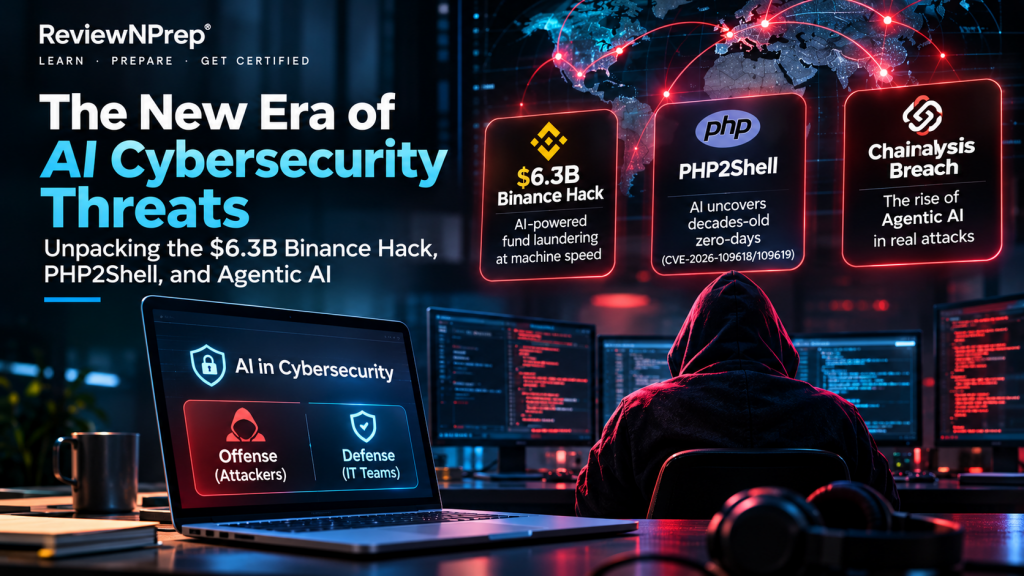
💡 Quick Answer: Artificial Intelligence is fundamentally shifting cybersecurity from human-speed to machine-speed. In recent weeks, we’ve seen AI used to discover decades-old core vulnerabilities (like PHP2Shell), power autonomous hacking tools (Chainalysis breach), and rapidly launder stolen funds across blockchains (the $6.3 billion Binance hack). To survive, modern IT teams must adopt AI-driven behavioral defense mechanisms while maintaining strict traditional security hygiene.
Late October 2026 was a cybersecurity nightmare that shook the tech and financial worlds. Headlines were dominated by a staggering $6.3 billion drained from Binance, a highly sophisticated breach at Chainalysis, and the discovery of a critical vulnerability affecting 70% of the internet.
These weren’t isolated incidents; they were a wake-up call. The thread connecting them all? Artificial Intelligence. We have officially crossed the threshold where AI is no longer just a defensive tool used by enterprise security teams, it is an active, aggressive weapon used by hackers to discover zero-days, automate breaches, and execute attacks at unprecedented speed.
Whether you are a developer, a system administrator, or studying for a cloud security certification, understanding how AI is reshaping the cybersecurity battlefield is critical. This guide breaks down the technical reality of recent AI-driven cyber threats, providing deep insights into what is actually happening in the trenches.
1. The $6.3 Billion Binance Hack: AI as a Laundering Engine
On October 29, 2026, attackers siphoned approximately $6.36 billion in digital assets from Binance in about 20 minutes the largest crypto theft in history. Because AI is at the center of the tech universe, rumors quickly spread that a super-intelligent AI breached the exchange.
The Initial Breach: Based on investigations by blockchain forensic firms, the attackers (linked to North Korea) did not use AI to pick the digital lock. Instead, they relied on a classic, human-centric vulnerability: they compromised a DevOps engineer’s laptop. From there, they accessed a service container and exploited pre-signed authorizations to move funds.
How AI Was Actually Used: While the initial access was traditional, the execution was not. Moving $6.3 billion across ten different blockchains in 20 minutes is not humanly possible. Chainalysis noted that the rapid generation of thousands of complex transactions suggested the heavy use of automated AI programs designed specifically to obfuscate the fund trails. AI wasn’t the lockpick; it was the getaway driver, operating at a scale and speed that overwhelmed traditional monitoring systems.
2. PHP2Shell: AI Uncovering Decades-Old Zero-Days
Perhaps the most alarming AI development of October 2026 was the disclosure of “PHP2Shell” (CVE-2026-109618 and CVE-2026-109619). These are critical remote code execution (RCE) vulnerabilities in the core PHP engine, earning a CVSS score of 9.2.
PHP powers nearly 70% of the web (including WordPress and Drupal). This memory-safety bug had been hiding in PHP’s source code for years. Human researchers had previously flagged the area but deemed it too difficult to exploit.
The AI Breakthrough: A security researcher, working alongside frontier AI models (like GPT-5.6 Sol and Gemini 4 Argon), was finally able to untangle the complex memory corruption bugs. AI drastically lowered the barrier, doing the heavy lifting of vulnerability research, exploit development, and patch validation. Within days of the patch leaking, attackers were using AI to instantly generate custom exploit payloads tailored to vulnerable servers across the globe.
3. The Chainalysis Breach: The Rise of “Offensive Agentic AI”
On October 30, 2026, blockchain intelligence firm Chainalysis disclosed a data breach exposing customer information. What made this attack unique was the methodology. Chainalysis reported that the attackers used “offensive agentic techniques.”
What does this mean? In the past, hackers wrote static scripts. If a script hit a firewall it didn’t expect, it failed. “Agentic AI” changes this. An autonomous AI agent can make decisions on the fly. It can probe a network, read the error logs when it gets blocked, autonomously rewrite its own code to bypass the block, and continue moving laterally through internal systems without a human hacker typing a single command. It is a tireless, adaptive digital burglar.
4. AI in Cybersecurity: Offense vs. Defense
AI is a double-edged sword. Here is a breakdown of how it is used by both the attackers (Red Team) and the defenders (Blue Team) in modern cloud environments.
| Attack Vector | How Hackers Use AI (Offense) | How IT Teams Use AI (Defense) |
| Vulnerability Exploitation | Using AI models to scan the internet for unpatched legacy code (like PHP2Shell) and autonomously writing custom exploits. | Deploying AI to continuously audit internal codebases, instantly identifying and suggesting remediation for vulnerable code before deployment. |
| Network Intrusion | Deploying “Agentic AI” that analyzes internal errors and autonomously adjusts tactics in seconds to bypass security controls. | Using predictive AI to monitor network traffic in real-time, instantly isolating compromised service containers when abnormal lateral movement is detected. |
| Social Engineering & Phishing | Generating flawless, personalized phishing emails or deepfake audio to compromise credentials (the root cause of the Binance hack). | Scanning communications for subtle behavioral anomalies, unnatural urgency, and hidden malicious intent that traditional spam filters miss. |
5. Why This Matters for Your IT Career
As AI reshapes the threat landscape, companies are desperate for professionals who understand how to secure these new environments. The days of relying solely on static firewalls are over.
If you are pursuing certifications like the AWS Certified Security – Specialty or CompTIA Security+, you must understand the concepts of Zero Trust architecture, least privilege access, and AI-driven anomaly detection. However, as the Binance hack proves, the human element protecting laptops, securing credentials, and maintaining strict DevOps hygiene remains the ultimate perimeter.
Frequently Asked Questions (FAQs)
Was the $6.3 billion Binance cryptocurrency theft caused by Artificial Intelligence?
No, but AI was heavily involved. Initial investigations indicate the breach was the result of a compromised DevOps laptop. However, the hackers utilized automated AI programs to generate thousands of rapid transactions across 10 blockchains in 20 minutes to launder the money and obscure the fund trails.
What is the PHP2Shell vulnerability?
PHP2Shell refers to critical memory-safety vulnerabilities (CVE-2026-109618 and 109619) in the core PHP engine. What makes it notable is that advanced frontier AI models (like Gemini 4 Argon and GPT-5.6 Sol) were instrumental in helping researchers finally discover and weaponize these deeply hidden flaws.
What are “offensive agentic techniques” in cybersecurity?
This refers to the use of autonomous AI agents (like those used in the recent Chainalysis breach). Unlike a rigid script, an AI agent can analyze a system, attempt a breach, read the error message when it fails, and automatically rewrite its own attack payload to try a new method all in seconds without human intervention.
Ready to Future-Proof Your IT Career?
Cybersecurity is evolving at machine speed. Validate your skills and learn to secure the cloud environments of tomorrow with verified practice exams and study resources.


Have questions or want to help the community? Share here.
We encourage our readers to share their unique experiences or ask questions to create a helpful and informative community. Our editors will also review every comment before publishing, ensuring our commitment to this community.