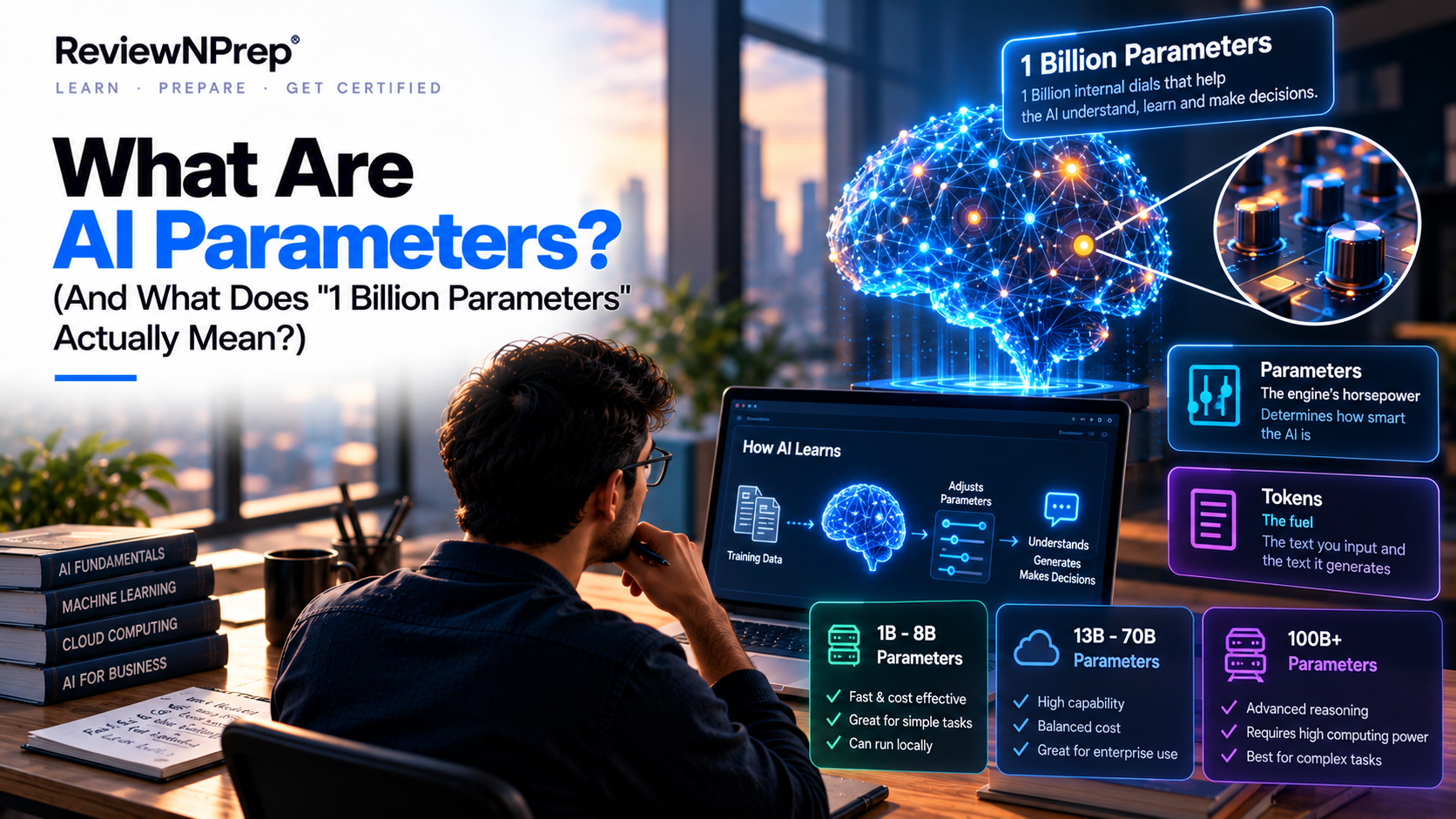
💡 Quick Answer: Think of an AI parameter as a “dial” or a “synapse” inside the AI’s brain. When tech companies say a model has “1 billion parameters,” it means the AI has 1 billion internal dials it mathematically adjusts to understand language, spot patterns, and make decisions. Generally, more parameters mean a smarter, more capable AI but they also mean exponentially higher cloud computing costs for your business.
Whenever a new Artificial Intelligence model is announced, tech companies love to brag about the numbers. You will see headlines like, “New Open-Source AI Released With 70 Billion Parameters!” or rumors that “GPT-4 has over a trillion parameters.”
But if you are a founder, a product manager, or an IT professional studying for a certification, what are they actually counting? Is a 70-billion parameter model automatically 70 times better than a 1-billion parameter model? And which one does your company actually need to run its day-to-day operations?
Understanding what a parameter is does not require a data science degree. This expanded guide breaks down this crucial AI concept into plain English. We will explore the soundboard analogy, the critical difference between parameters and tokens, and why bigger isn’t always better in enterprise AI.
1. What is an AI Parameter? (The Soundboard Analogy)
To understand parameters, imagine a sound engineer working at a massive stadium concert. In front of the engineer is a giant mixing board covered in little knobs, dials, and sliders. By adjusting these dials, the engineer controls the bass, the treble, the volume of the lead singer, and the echo of the drums until the music sounds perfect.
In the world of Artificial Intelligence, parameters are those dials.
When an AI is being trained on millions of documents, it mathematically adjusts its internal “dials” to learn the relationship between words. For example, it adjusts a set of dials to learn that the word “peanut” is usually followed by “butter,” or that an angry customer email containing the word “refund” should be flagged as “urgent.”
So, when a model has 1 billion parameters, it means the software has 1 billion tiny internal variables it has fine-tuned to understand human language, logic, programming code, and context.
2. Parameters vs. Tokens: Clearing the Biggest Confusion
Business leaders often confuse “parameters” with “tokens.” If you want to control your AI budget, you must know the difference:
- Parameters = The Engine’s Horsepower: This is the static size of the AI’s brain. It dictates how smart the AI is and how capable it is of complex reasoning. You buy or rent an AI based on its parameter size.
- Tokens = The Fuel: Tokens are the actual pieces of text (words or syllables) you feed into the AI when you type a prompt, and the text the AI generates back to you. You are billed by cloud providers (like AWS or Azure) based on the number of tokens processed.
In short: Parameters determine how smart the AI is; tokens determine how much text you are asking it to read and write right now.
3. The Cost of Intelligence: Why Parameter Count Matters
In AI, size correlates directly with capability, but it also heavily dictates cost. Here is why the parameter count is the most important spec on an AI’s resume:
- Better Reasoning & Nuance: A model with 1 billion parameters is great at basic grammar and summarizing short text. A model with 100 billion parameters can pass the Bar Exam, write complex Python scripts, and understand subtle sarcasm.
- Hardware & Hosting Costs: You can run a small 7-billion parameter model locally on a good MacBook for free. But a 100-billion parameter model requires a massive data center filled with expensive specialized graphics cards (GPUs). Running giant models costs businesses thousands of dollars a month in cloud computing fees.
4. Comparing AI Sizes: Which One Do You Actually Need at Work?
You wouldn’t buy an 18-wheeler truck just to deliver a single pizza. The same logic applies to AI. Matching the parameter size to the specific business task is the secret to scaling AI profitably.
| Model Size (Parameters) | Capability & Cost Level | Day-to-Day Workplace Example |
| Small (1B to 8B) | Fast, cheap, and hyper-focused. Low latency. Can run locally on edge devices without the internet. | Reading incoming customer emails and categorizing them as “Support,” “Sales,” or “Spam.” Perfect for basic data extraction. |
| Medium (13B to 70B) | Highly capable for enterprise work. Balances great reasoning with manageable cloud hosting costs. | Drafting professional marketing blogs, acting as an internal HR chatbot to answer complex policy questions, or summarizing quarterly reports. |
| Massive (100B to 1 Trillion+) | PhD-level reasoning. Extremely expensive and slower, requiring supercomputers to run (e.g., GPT-4, Claude 3 Opus). | Writing complex software architectures from scratch, analyzing 50-page legal contracts for loopholes, or solving advanced mathematical logic problems. |
5. The New Trend: Why “Smaller” is Suddenly Better
For the last few years, the AI industry believed “bigger is always better.” But recently, the trend has shifted toward Small Language Models (SLMs) in the 3-billion to 8-billion parameter range (like Meta’s Llama 3 8B or Microsoft’s Phi-3). Why?
Quality of training data beats quantity of parameters. If you train a small 8-billion parameter model exclusively on high-quality, textbook-grade data, it can outperform a 50-billion parameter model trained on low-quality internet junk. For enterprise businesses, SLMs offer 90% of the capability at 10% of the computing cost.
6. Why Understanding Parameters Helps Your IT Career
If you are working in IT, product management, or digital marketing, vendors will constantly try to upsell you on “Enterprise AI.” Knowing the basics of parameters gives you an immediate advantage:
- You can spot vendor overkill: If your company just wants an AI to extract dates and prices from scanned receipts, you know you don’t need to pay for a massive 70-billion parameter API. A tiny, specialized 1-billion parameter model will do it faster and cheaper.
- You can ace your IT Certifications: Exams like the AWS Certified AI Practitioner or Azure AI Fundamentals strictly test your ability to match the right size machine learning model to the right business use case to optimize cloud costs.
Frequently Asked Questions (FAQs)
What exactly is a parameter in AI?
A parameter is a numerical variable (a weight or a bias) inside an artificial neural network. The AI adjusts these numbers during its training phase to learn patterns in data. Think of them as the “synapses” in an AI’s digital brain.
Does a higher parameter count always mean the AI is better?
Not anymore. While bigger models generally have better baseline reasoning, the quality of the training data matters just as much (known as the Chinchilla scaling laws). A smaller model trained on premium data can easily beat a larger model trained on uncurated data.
What does “LLM” stand for in AI?
LLM stands for Large Language Model. It is a type of deep learning AI (like ChatGPT or Gemini) that has billions of parameters specifically designed to understand, translate, predict, and generate human text.
Can I run a 1-billion parameter AI on my personal computer?
Yes! Models in the 1-billion to 8-billion parameter range are considered “small” in the AI world and can often be run locally on a modern laptop (using tools like LM Studio or Ollama) without needing an internet connection.
Ready to Turn Your AI Knowledge into a Certification?
Understanding the architecture behind AI puts you ahead of 90% of professionals. If you want to validate your knowledge, foundational certifications like AWS AI Practitioner will prove your expertise to employers.
👉 Try Free Practice Exams | 👉 Build Your Custom Flashcards
Related on ReviewNPrep:
• What Is AI? A Simple Guide to Artificial Intelligence
• What Is Machine Learning? A Simple Guide With Everyday Examples
• What Are the Different Types of AI? A Simple Guide for the Modern Workplace


Have questions or want to help the community? Share here.
We encourage our readers to share their unique experiences or ask questions to create a helpful and informative community. Our editors will also review every comment before publishing, ensuring our commitment to this community.