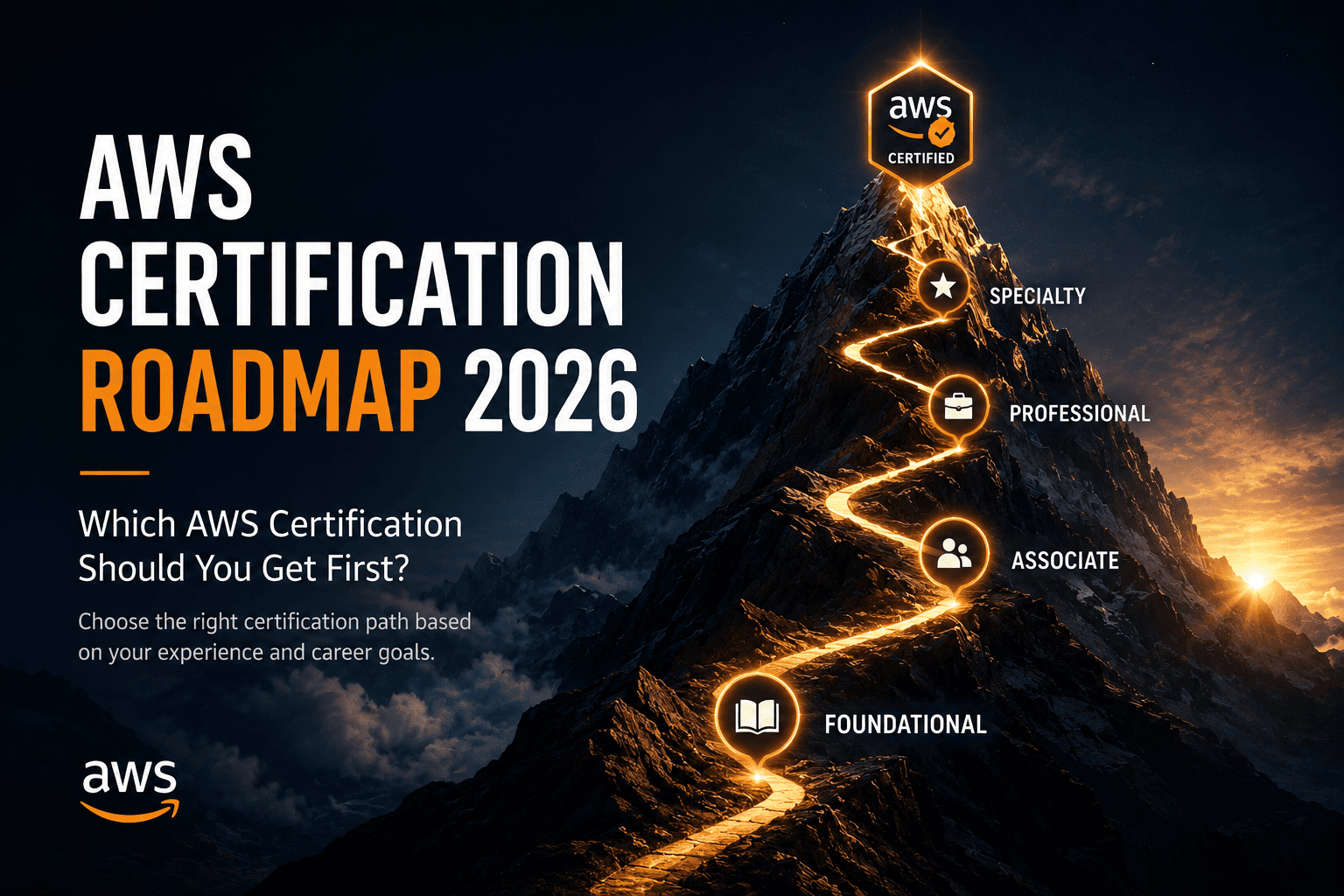
Start with the AWS Certified Cloud Practitioner (CLF-C02) if you are new to the cloud, or the AI Practitioner (AIF-C01) if you are focused on AI/ML. From there, select one Associate-level track that aligns with your role. Solutions Architect Associate for general cloud roles, Developer Associate for engineers, SysOps Administrator Associate for operations, or Data Engineer / Machine Learning Engineer Associate for data-focused roles. Move to a Professional certification only after gaining 1-2 years of hands-on experience, and treat Specialty certifications as optional add-ons for specific niches rather than required steps.
AWS currently offers over a dozen certifications distributed across four levels, which often causes individuals to freeze before booking their first exam. Searching “AWS certification path” on Google yields conflicting opinions, such as starting with Cloud Practitioner, skipping it, going straight for Solutions Architect, or quickly chasing the Professional tier. The confusion stems from trying to sequence a credential for a role you do not yet hold. This roadmap breaks down the decision by level, role, and the 2026 changes to the AWS certification catalog, including the direction of the Machine Learning track and which new exams are worthwhile.
AWS Certification Levels at a Glance
| Level | Cost (USD) | Prep Time | Who It’s For |
| Foundational | $100 | 4-6 weeks | New to cloud, career changers, non-technical roles |
| Associate | $150 | 6-10 weeks | Engineers, admins, and architects with 6-12 months hands-on |
| Professional | $300 | 8-16 weeks | 1-2+ years of hands-on AWS experience |
| Specialty | $300 | 8-12 weeks | A specific niche: security, networking, or a focused domain |
Step 1: Start at the Foundational Level
- For Cloud Beginners: If you are new to cloud computing, start with the AWS Certified Cloud Practitioner (CLF-C02). This exam covers core cloud concepts, AWS’s global infrastructure, billing, and basic security, requiring no coding or hands-on labs.
- For AI/ML Focus: If your career goal is AI or machine learning, the AWS Certified AI Practitioner (AIF-C01) is the newer and more relevant starting point. It tests generative AI concepts and AWS’s AI/ML services conceptually, without the deep math or model-building knowledge required at the Associate level.
- Note: Neither foundational exam is a hard requirement, as AWS does not enforce prerequisites. However, skipping this level usually means learning core vocabulary while preparing for a harder exam, which ultimately slows down the process.
Step 2: Choose Your Associate-Level Track
This is the most critical decision in the roadmap because the Associate tier splits certifications by role rather than general knowledge.
- Solutions Architect Associate (SAA-C03): The most popular track covering scalable and secure system design on AWS. Best for architects, generalist engineers, or those unsure of which track to choose.
- Developer Associate (DVA-C02): Focuses on building and deploying applications. Best for software engineers writing code against AWS APIs and SDKs.
- SysOps Administrator Associate (SOA-C02): Focuses on deployment, monitoring, and operations. Best for system administrators and operations-focused engineers.
- Data Engineer Associate: Focuses on building and maintaining data pipelines. Best for candidates transitioning into data engineering.
- Machine Learning Engineer Associate: Focuses on implementing and operating ML workloads. Best for engineers supporting day-to-day ML systems.
Most candidates should select exactly one Associate track based on their current or desired job title. A single Associate certification backed by real hands-on practice holds more weight with hiring managers than three superficial Associate badges.
Step 3: Move to Professional But Only When You’re Ready
The Professional tier tests judgment derived from production experience, including trade-offs between organizational policies and account controls, multi-account architecture, and enterprise-scale decision-making that cannot be learned from a study guide alone.
- Paths: The AWS Certified Solutions Architect Professional (SAP-C02) follows the Solutions Architect Associate. The AWS Certified DevOps Engineer Professional (DOP-C02) naturally follows the Developer or SysOps Associate. The Generative AI Developer Professional is the new path for candidates building production AI applications.
- Warning: A common mistake is scheduling a Professional exam shortly after passing an Associate exam without gaining production experience. Candidates who do this often fail because the exam tests scenarios they haven’t experienced. It is recommended to have at least a year of real-world AWS work before attempting this tier.
Step 4: Treat Specialty Certifications as Optional, Not Mandatory
Specialty certifications validate deep expertise in narrow domains.
- In-Demand Specs: AWS Certified Security Specialty (SCS-C02) and Advanced Networking Specialty (ANS-C01) are the most in-demand, with Networking widely considered the hardest overall AWS exam with a low pass rate.
- 2026 Update: The AWS Certified Machine Learning – Specialty is retiring, with the final exam date set for March 31, 2026. Candidates should plan around the AI Practitioner and Machine Learning Engineer – Associate instead.
- Guidance: Only pursue a Specialty certification if it directly aligns with your job; for example, a network engineer moving into cloud infrastructure benefits from Advanced Networking, while a general cloud engineer does not.
Common Mistakes to Avoid When Planning Your Path
- Collecting Associate certifications instead of specializing: Three shallow Associate badges are less valuable than one certification backed by real projects.
- Jumping to Professional without production experience: The Professional tier tests judgment, so gain real project experience first.
- Chasing a retiring or low-relevance Specialty exam: Always review AWS’s current exam list before studying, as the catalog changes frequently.
- Studying without exam-accurate practice questions: AWS exams are scenario-based; practicing with real scenarios matters more than just reading documentation.
FAQs
Which AWS certification should I get first? Most candidates should start with AWS Certified Cloud Practitioner (CLF-C02) if new to cloud computing, or AWS Certified AI Practitioner (AIF-C01) for an AI/ML focus. Both take about 4-6 weeks of part-time study.
Do I need Cloud Practitioner before Solutions Architect Associate? No, AWS does not enforce prerequisites. However, Cloud Practitioner builds foundational knowledge that makes Associate-level exams easier, so it is recommended for those without hands-on experience.
How long does it take to complete the full AWS certification roadmap? Going from zero experience to a Professional certification typically takes 8-14 months of consistent part-time study: 4-6 weeks for foundational, 6-10 weeks for Associate, and 8-16 weeks for Professional.
Is AWS Certified Machine Learning – Specialty still worth pursuing? No, AWS is retiring this exam on March 31, 2026. Focus on the AI Practitioner and Machine Learning Engineer – Associate instead.
How much do AWS certification exams cost in 2026? Foundational exams cost $100 USD, Associate exams cost $150 USD, and Professional/Specialty exams cost $300 USD (before local taxes). Always confirm regional pricing in your AWS Certification Account.
Do AWS certifications expire? Yes, they are valid for three years. Passing a Professional-level exam automatically recertifies the related Associate credential.
Further Reading