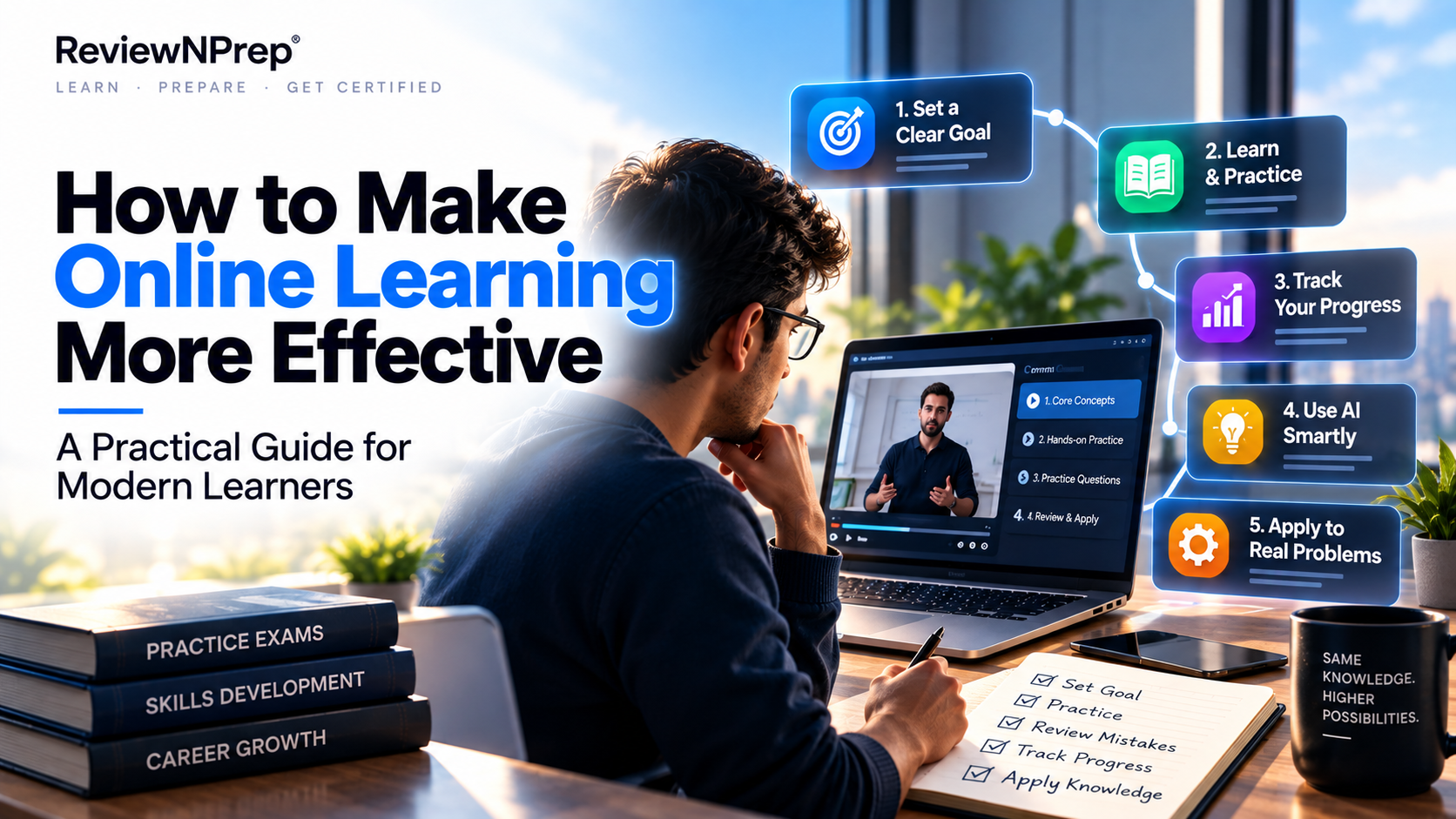
Online learning has made education more accessible than ever. You can learn a new skill, prepare for a certification exam, or develop your career without being in a traditional classroom.
But simply watching videos and completing lessons does not guarantee that you will remember or apply what you learned.
Effective online learning is about what you do with the information, not just how much information you consume. Here are practical ways to make online learning more effective.
1. Start With a Specific Learning Goal
Before starting an online course, define what you want to achieve.
Instead of: “I want to learn cloud computing.”
Try: “I want to understand the core AWS services and prepare for the AWS Certified Cloud Practitioner exam.”
A specific goal makes it easier to choose the right course, identify relevant topics, and measure your progress. For certification learners, this is especially important because different certifications require different skills and levels of preparation.
2. Don’t Just Watch Practice
One of the biggest problems with online learning is passive learning. Watching a 60-minute lesson can feel productive, but understanding a concept becomes much stronger when you actually use it.
A simple learning cycle is: Learn → Practice → Review → Apply
For certification preparation, practice exams are particularly useful because they help you identify topics you understand and areas that need more work. ReviewNPrep’s marketplace offers practice exams and courses across areas such as AWS, Salesforce, Microsoft Azure, Google Cloud, project management, DevOps and more. (marketplace.reviewnprep.com)
3. Use Your Mistakes as a Study Guide
Getting a practice question wrong is not necessarily a bad result. It tells you where your knowledge needs improvement. Instead of simply checking the correct answer, ask:
- Why was my answer wrong?
- What concept did I misunderstand?
- Was I confused between two similar options?
- Can I explain the correct answer in my own words?
This turns a practice test into a personalized study plan. ReviewNPrep also recommends reviewing explanations for both correct and incorrect answers because the explanation can strengthen understanding rather than simply reinforce memorization. (reviewnprep.com)
4. Choose an Online Learning Environment That Encourages Participation
The technology behind online education also matters. A good online classroom should make it easier for learners to participate, ask questions, practice concepts, and receive useful feedback.
Modern platforms can support features such as interactive quizzes, polls, transcription, translation and learning analytics instead of relying only on video calls and presentations. For example, HigherEdLab’s online AI classroom platform includes customizable online classrooms along with interactive polls, quizzes, transcription, real-time translation and analytics designed to support online learning experiences. (Start Online Classes on BigBlueButton)
The important point is not the number of features. The technology should help learners participate and understand, not simply give them more screens to look at.
5. Use AI as a Learning Assistant, Not a Shortcut
AI tools can make learning faster, but using AI to avoid thinking defeats the purpose of learning. Instead, use AI to:
- Explain difficult concepts in simpler language
- Create additional examples
- Generate questions for self-testing
- Compare two concepts
- Identify gaps in your understanding
- Help you brainstorm practical applications
Then verify important information against reliable sources. The goal should be better understanding, not simply getting an answer faster.
6. Connect Learning to Real Problems
Knowledge becomes more valuable when you can apply it. If you are learning data engineering, work with data. If you are learning cloud computing, build a small cloud project. If you are preparing for a professional certification, connect exam concepts to real workplace scenarios.
This creates a bridge between:
Learning → Practice → Application → Professional Skill
That bridge is what turns an online course into meaningful professional development.
7. Measure Progress by Capability, Not Hours
Spending 20 hours watching courses does not necessarily mean you are ready. A better question is: “What can I do now that I couldn’t do before?”
For certification preparation, useful indicators include:
- Practice exam performance
- Weak and strong topic areas
- Ability to explain concepts
- Ability to solve scenario-based questions
- Ability to apply knowledge to practical situations
ReviewNPrep’s current learning experience follows a similar principle by combining practice, review and progress tracking so learners can identify what to focus on next. (rnpmkt-staging.reviewnprep.com)
A Simple Framework for Better Online Learning
You don’t need a complicated system. Use this approach, which works particularly well for online courses, professional certifications, and technical skill development:
| Step | Action |
| 1. Learn | Understand the concept. |
| 2. Practice | Test yourself without looking at the answer. |
| 3. Review | Understand your mistakes. |
| 4. Apply | Use the concept in a practical situation. |
| 5. Repeat | Return to weak areas until you can apply them confidently. |
Frequently Asked Questions
1. What is effective online learning?
Effective online learning is an approach that combines learning, active practice, feedback, and real-world application rather than relying only on watching lessons or completing course modules.
2. How can I make online learning more effective?
Set a specific learning goal, actively practice what you learn, review mistakes, apply concepts to real problems, and regularly measure what you can actually do with your knowledge.
3. Is online learning good for certification preparation?
Yes. Online learning can be useful for certification preparation when it combines structured learning with practice questions, explanations, progress tracking, and opportunities to apply the concepts.
4. Are practice exams useful for certification preparation?
Yes. Practice exams can help identify knowledge gaps, familiarize learners with question formats, and show which topics need additional review before the actual exam.
5. How can AI help with online learning?
AI can help explain difficult concepts, create practice questions, provide examples, compare concepts, and help learners identify gaps in their understanding. It should support learning rather than replace independent thinking.
6. What is active learning?
Active learning means participating in the learning process instead of only consuming information. Examples include answering questions, solving problems, explaining concepts, completing projects, and applying knowledge to real situations.
7. How do I know if I am actually learning?
Measure your ability to explain, recall, solve, and apply what you learned. Completing a course or spending a certain number of hours studying does not necessarily mean you have mastered the subject.
8. What should I look for in an online learning platform?
Look for clear course content, practical exercises, assessments, feedback, progress tracking, and an interactive learning environment that supports participation and application.
9. Can online learning help with professional development?
Yes. Online learning can help professionals develop technical and workplace skills, prepare for certifications, and build knowledge that can be applied to current or future roles.
10. What is the best way to prepare for an online certification exam?
A practical approach is to learn the exam topics, practice with realistic questions, review incorrect answers, focus on weak areas, and repeat practice until you can consistently apply the concepts.
Online learning is not becoming less important. It is becoming more practical. The learners who benefit most are not necessarily the ones who consume the most courses. They are the ones who learn actively, practice regularly, understand their mistakes and apply what they know.
Whether you are learning a new technology or preparing for your next professional certification, the goal should be simple: Don’t just finish the course. Build the ability to use what you learned.
👉 Explore certification preparation, practice exams and learning resources on ReviewNPrep.


Have questions or want to help the community? Share here.
We encourage our readers to share their unique experiences or ask questions to create a helpful and informative community. Our editors will also review every comment before publishing, ensuring our commitment to this community.