Quick Answer:
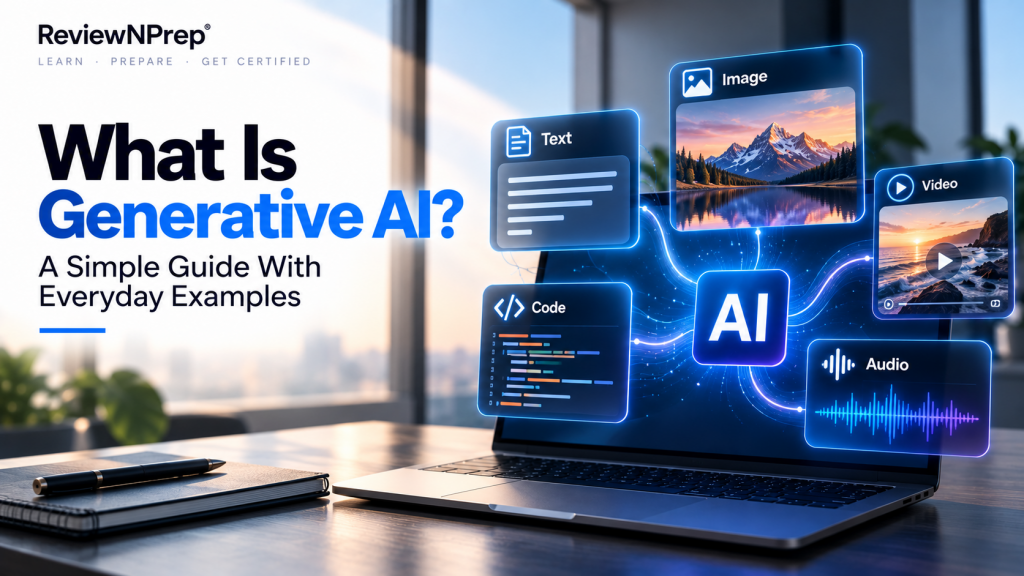
Generative AI is a type of artificial intelligence that creates new content, text, images, audio, video, or code instead of just analyzing or sorting existing data. It learns patterns from massive amounts of existing examples, then uses those patterns to produce new output that resembles what it learned from. ChatGPT-style chatbots, AI image generators, and AI coding assistants are all everyday examples already in wide use.
This is the fourth guide in ReviewNPrep’s AI basics series, following what AI is, what machine learning is, and what deep learning is. Generative AI is the specific branch behind most of the AI tools that made headlines over the past few years ChatGPT, AI image generators, and AI coding assistants are all generative AI, built on the deep learning foundations covered in the last guide.
If deep learning was about recognizing patterns, this is a cat, this is spam generative AI is about using those same learned patterns to produce something brand new.
What Generative AI Actually Means, in Plain English
Most earlier AI systems were built to make a decision about something that already exists: is this email spam, is this a photo of a dog, should this loan be approved. That’s often called discriminative AI. It sorts, labels, or classifies existing input.
Generative AI flips the task around. Instead of judging existing content, it creates new content that didn’t exist before a new sentence, a new image, a new piece of code based on patterns it learned from huge amounts of training examples. Ask it to write a product description or generate an image of a mountain at sunset, and it produces something new, built from patterns it absorbed rather than a database lookup of an existing answer.
Discriminative AI vs. Generative AI
| Discriminative AI | Generative AI | |
| What it does | Sorts, labels, or classifies existing input | Creates new content that didn’t exist before |
| Typical question | “Is this spam or not?” | “Write me an email about this topic.” |
| Everyday example | A spam filter, a fraud detection system | A chatbot, an AI image generator |
What Is a Large Language Model (LLM)?
A large language model, or LLM, is the specific type of generative AI behind text-based tools like ChatGPT. It’s trained on enormous amounts of written text books, articles, websites, code and learns the statistical patterns of how language flows: which words and ideas tend to follow which other words and ideas.
The simplest way to picture it: the predictive text feature on your phone’s keyboard guesses your next word based on the last one or two words you typed. An LLM does something similar, but at a vastly larger scale considering much more context at once, trained on far more text, and capable of producing coherent paragraphs rather than single-word suggestions.
How Generative AI Actually Creates New Content
Most generative AI works through some version of the same underlying idea: predicting the most plausible next piece of something, one small step at a time, based on everything it learned during training.
- Text: an LLM generates a sentence by predicting the most likely next word, one word at a time, repeatedly each new word chosen based on everything written so far.
- Images: many image generators start from random visual noise and refine it in small steps, gradually shaping that noise into a coherent picture that matches a text description.
- Code: an AI coding assistant predicts the most probable next line of code based on the surrounding code and a vast amount of code it was trained on.
None of this involves the AI “understanding” the content the way a person does. It’s pattern prediction, repeated many times in sequence, at a scale large enough to produce output that reads or looks remarkably coherent.
Everyday Examples of Generative AI You Already Use
- AI chatbots draft emails, answer questions, summarize documents, or brainstorm ideas in natural language.
- AI image generators create original images from a written description.
- AI coding assistants suggest or complete code as a developer types.
- Voice and music generation clone a voice from a short sample, or generate original background music.
- Smart writing assistance grammar and style tools that now suggest full rewritten sentences, not just corrections.
Common Generative AI Misconceptions
Misconception: Generative AI “knows” facts the way a person does.
It predicts statistically plausible text based on patterns in its training data; it has no built-in mechanism for verifying whether a statement is actually true, which is why confidently wrong answers, often called “hallucinations,” happen even in fluent, well-formatted responses.
Misconception: Generative AI output is fully original.
Output is generated from patterns learned across the training data, which raises real, actively debated questions around originality, attribution, and copyright questions the field hasn’t fully settled yet.
Misconception: More impressive output means the AI is reasoning like a human.
Fluent, well-structured text can create a strong impression of understanding, but the underlying process is still pattern prediction not reasoning, verification, or awareness of meaning.
Misconception: Generative AI is only useful for writing and art.
Beyond text and images, generative AI is used for drug molecule design, synthetic data generation for training other models, and code generation well outside the creative-writing use cases most people encounter first.
Why Generative AI Basics Matter for Your Career
Prompt engineering the practice of phrasing requests to generative AI tools to get better, more accurate output has become a genuinely useful skill across roles, not just for people building AI products. How a request is worded meaningfully changes the quality of what comes back, whether you’re asking for a summary, a draft, or a piece of code.
For structured learning, AWS Certified AI Practitioner and Azure AI Fundamentals both cover generative AI concepts at a foundational, no-code level. For hands-on roles building generative AI applications, AWS’s Generative AI Developer – Professional certification covered in ReviewNPrep’s AWS Certification Roadmap goes considerably deeper, and pairs well with the daily AI study routine ReviewNPrep recommends for exam prep generally.
FAQs
What is generative AI in simple terms?
Generative AI is a type of artificial intelligence that creates new content, text, images, audio, video, or code instead of just analyzing or sorting existing data. It learns patterns from huge amounts of existing examples, then uses those patterns to produce brand-new output that resembles what it learned from, without copying any single example directly.
What’s the difference between generative AI and a large language model?
Generative AI is the broad category: any AI that creates new content. A large language model (LLM) is one specific kind of generative AI, focused on text trained on huge amounts of written language to generate human-like sentences, answer questions, or write code.
How does generative AI actually create new content?
At its core, most generative AI works by predicting what should come next, one small piece at a time, based on patterns learned from massive training data. A text model predicts the next word repeatedly to build a sentence; an image model refines random noise repeatedly until it resembles a coherent picture.
Why does generative AI sometimes make things up?
This is often called “hallucination.” Generative AI predicts patterns that sound statistically plausible based on its training data it has no built-in way to verify facts, so a confident, fluent-sounding answer can still be factually wrong. Always verify important facts against a reliable source.
What are some everyday examples of generative AI?
AI chatbots that answer questions or draft emails, image generators that create pictures from a text description, AI coding assistants that suggest code, and voice-cloning or music-generation tools are all common examples of generative AI already in wide use.
Is prompt engineering a real skill worth learning?
Yes, in a practical sense. How you phrase a request to a generative AI tool meaningfully affects the quality of what it produces, and this skill has become relevant across roles not just for engineers building AI products, but for anyone using AI tools day to day.
What certifications cover generative AI?
AWS Certified AI Practitioner and Azure AI Fundamentals both cover generative AI concepts at a foundational, no-code level. For hands-on roles building generative AI applications, AWS’s newer Generative AI Developer – Professional certification goes considerably deeper.
Ready to Build on These Concepts?
Whether you’re starting with AI Practitioner or working toward Generative AI Developer – Professional, put your understanding to the test with ReviewNPrep’s free practice exams and flashcards.
Related on ReviewNPrep:
- What Is AI? A Simple Guide to Artificial Intelligence
- What Is Machine Learning? A Simple Guide With Everyday Examples
- What Is Deep Learning? A Simple Guide With Everyday Examples
- AWS Certification Roadmap 2026