The Project Management Professional (PMP) is globally recognized as the top project management credential, but preparing for it can be confusing. Between the multiple eligibility paths, the total exam refresh by the Project Management Institute (PMI) in July 2026, and a fee structure that has changed twice this year, candidates need up-to-date information.
Here is your comprehensive guide to navigating the new requirements, understanding the exam changes, and building a study plan that won’t waste your time on outdated materials.
⏱️ Quick Answer: The PMP at a Glance
- Issuing Body: Project Management Institute (PMI).
- Format: 180 questions over 240 minutes via computer-based testing (available at test centers or as an online proctored exam).
- Exam Fee: Approximately $400-450 for PMI members and $650-675 for non-members. Always verify current pricing on PMI’s official site before registering.
- Alignment: PMBOK Guide, 8th Edition, effective as of the July 9, 2026, refresh.
- Validity & Renewal: The certification is valid for 3 years from your pass date, and you must earn 60 Professional Development Units (PDUs) to renew it.
Am I Eligible for the PMP Exam?
PMI qualifies candidates through one of two primary paths. Both paths require 35 hours of formal project management education, though holding an active CAPM certification automatically satisfies this requirement.
- The Degree Path: You need a four-year (bachelor’s) degree combined with 36 months of project leadership experience.
- The No-Degree Path: You need a high school diploma or an associate degree combined with 60 months of project leadership experience.
- The Experience Window: All qualifying project experience must fall within the past 10 years, which is a wider window than PMI’s previous 8-year requirement. If your experience spans multiple roles, be sure to document each project separately for the application audit.
What Changed in the July 2026 PMP Refresh?
PMI updated the PMP exam on July 9, 2026, to align with the newly released PMBOK Guide 8th Edition. If you are studying from older materials, some of your content is likely out of date.
- Rebalanced Domains: The exam’s three domain weightings shifted to place a stronger emphasis on strategic alignment and the business environment.
- Extended Time: The total exam time was extended to give candidates more time per question, though the total number of questions remains at 180.
- New Content Areas: The exam now tests topics that did not appear on the previous version, including AI-assisted project management, sustainability considerations, and value delivery.
The Three Exam Domains
- People: Tests your ability to lead teams, resolve conflicts, engage stakeholders, and build a collaborative environment.
- Process: Covers the mechanics of running a project including scope, schedule, budget, risk, and quality across predictive, agile, and hybrid approaches.
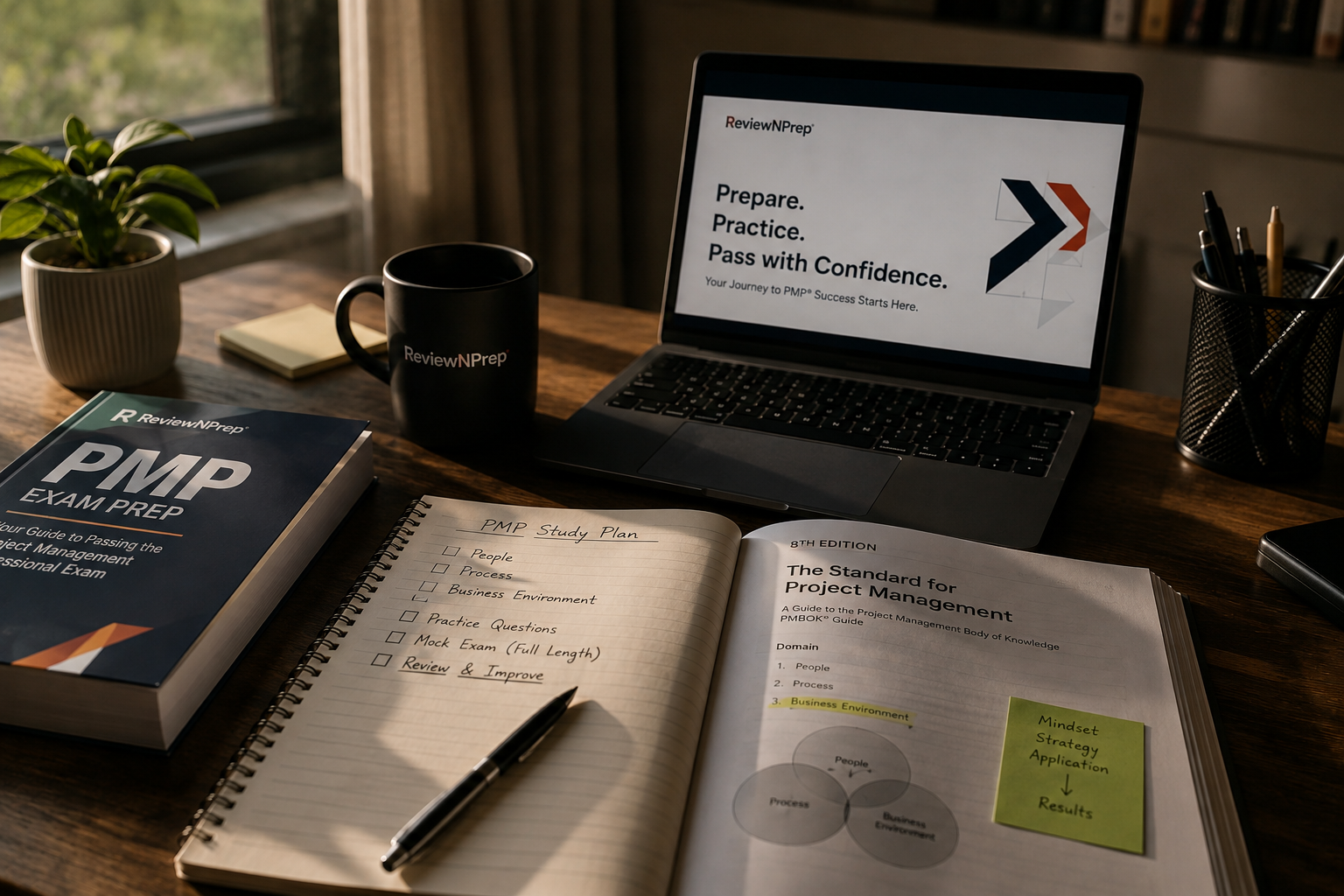
- Business Environment: Focuses on aligning projects with organizational strategy, navigating external factors, ensuring compliance, and delivering measurable business value.
How to Prepare: A Six-Step Study Plan
- Confirm your eligibility early: Register your application with PMI before you begin studying, as the audit process can take time and you don’t want it delaying your exam date.
- Get the right education: Complete your 35 contact hours using a course built specifically around the post-July 2026 exam content outline.
- Study proportionally: Allocate your study time based on the exam’s domain weightings, keeping in mind that Process and Business Environment carry a significant portion of the exam.
- Practice scenario-based questions: Focus on situational practice rather than term memorization. PMP questions describe a scenario and ask what the project manager should do next.
- Take full-length mock exams: Build your stamina for the 240-minute format by taking timed practice exams under realistic conditions.
- Review your mistakes: Review every incorrect answer to understand why the plausible distractor option was wrong, as this is where the most valuable learning happens.
Common Mistakes Candidates Make
- Memorizing PMBOK definitions: The exam tests applied judgment in real scenarios, not your ability to recite the name of a process.
- Underestimating agile and hybrid content: It is an outdated assumption to treat the PMP as a purely traditional-waterfall exam; it now heavily blends predictive, agile, and hybrid approaches.
- Skipping full-length timed mocks: Sustained decision-making for 240 minutes is a unique skill that requires practice before exam day.
- Studying from pre-refresh material: Materials published before the July 2026 update may lack coverage of new domain weightings and topics like AI-assisted project management.
Is the PMP Certification Worth It in 2026?
For professionals who are already leading projects, the PMP remains the most widely recognized project management credential globally and is frequently associated with a meaningful salary premium. However, it provides less value for candidates who lack real project leadership experience, as the exam is designed to test applied judgment rather than memorized steps.
Ready to start your PMP prep? Pair your 35-hour course with ReviewNPrep’s practice exams and flashcards aligned to the current content outline to ensure you are ready for exam day.
Further Reading: