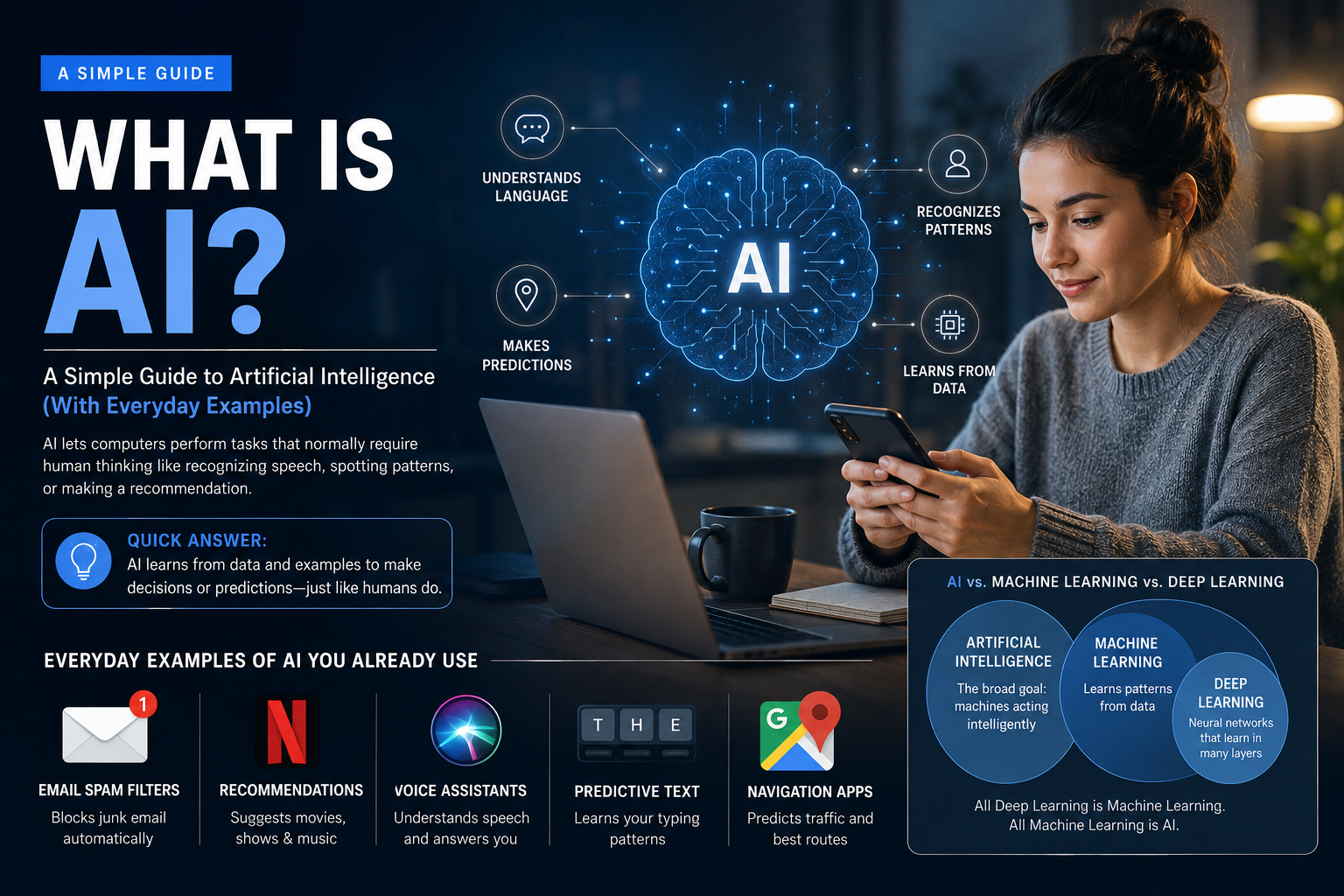
You probably used AI three times before your morning coffee today. Did you unlock your phone with your face? Check a weather app? Read an email that automatically filtered out a spam message? That is Artificial Intelligence in action.
“AI” shows up in headlines, product ads, and job postings so often that the term has started to feel bigger and more mysterious than it actually is. But strip away the tech jargon, and the core idea is incredibly simple.
This guide answers the most searched questions about AI, explains how it differs from machine learning, and shows why you don’t need to be a programmer to understand it.
Quick Answer: What is AI in simple terms?
Artificial intelligence (AI) is technology that lets computers perform tasks that normally require human thinking such as recognizing speech, spotting patterns, or making a recommendation. Instead of following fixed, hand-written instructions from a programmer, AI learns from examples and data. You already use AI every day: spam filters, Netflix recommendations, Siri, predictive text, and Google Maps traffic predictions are all built on it.
What AI Actually Means, in Plain English
Think about how traditional software works: a programmer writes exact instructions, like a recipe. “If the user clicks this button, do that.” The computer never deviates from the recipe.
AI works differently. Instead of a recipe, you show the computer thousands of examples for instance, thousands of emails labeled “spam” or “not spam” and it learns the patterns that separate the two on its own. Nobody writes a rule saying “spam emails contain the word ‘FREE’ in all caps.” The system figures that out from the data.
That’s the entire concept: learning from examples instead of following fixed rules in order to make a decision or prediction.
AI vs. Machine Learning vs. Deep Learning (What’s the Difference?)
These three terms get used interchangeably, but they are not the same thing. Think of them like nesting dolls:
| Term | What It Means | Everyday Example |
| Artificial Intelligence (AI) | The broad goal: getting a machine to act intelligently, using any method. | A chess program that plays a strong game. |
| Machine Learning (ML) | The main method used to achieve AI the computer learns patterns from data instead of following fixed rules. | A spam filter that gets better the more emails it sees. |
| Deep Learning | A more advanced type of machine learning that uses layered “neural networks” loosely inspired by the brain. | Face unlock on your phone, or voice recognition in Siri. |
In short: all deep learning is machine learning, and all machine learning is a form of AI but not all AI uses machine learning.
Everyday Examples of AI You Already Use
Most AI isn’t a talking robot; it’s a quiet feature built into products you already use.
· Spam filters: Learn to recognize junk email patterns instead of following a fixed block list.
· Streaming recommendations: Netflix, YouTube, and Spotify suggest content based on patterns in what you and similar users watched or listened to.
· Voice assistants: Siri, Alexa, and Google Assistant convert speech to text and interpret intent using AI.
· Predictive text: Your phone’s keyboard learns your typing patterns to guess the next word.
· Navigation apps: Google Maps and Waze predict traffic and travel time using patterns in historical and live location data.
Narrow AI vs. General AI: Will AI Take Over?
Every example above is what’s called narrow AIs system built to do one specific task well. It can’t do anything outside that task. A spam filter can’t suggest a movie, and a navigation app can’t write an email.
General AI a system with human-level intelligence across any task, the way a person can is still hypothetical. Despite how AI is often portrayed in sci-fi movies, nothing in wide use today is general AI. Everything currently available is narrow, task-specific AI.
Common AI Misconceptions Busted
· Misconception: AI “thinks” like a human. It doesn’t. AI systems recognize statistical patterns in data. They don’t reason, understand meaning, or have intentions, even when they output conversational text.
· Misconception: AI is always accurate. AI is only as good as the data it learned from. Biased, incomplete, or outdated training data produces biased, incomplete, or outdated results.
· Misconception: AI will replace most jobs outright. The more consistent pattern is AI changing which tasks a job involves, automating repetitive work while shifting people toward judgment, oversight, and strategy.
Why AI Basics Are Worth Knowing for Your Career
You don’t need to become a data scientist to benefit from understanding AI. A growing number of rolesproject management, marketing, operations, IT support now involve working alongside AI-powered tools.
Certification bodies have responded directly. Exams like the AWS Certified AI Practitioner and Microsoft’s Azure AI Fundamentals test conceptual AI and machine learning knowledge without requiring coding. If the concepts in this guide made sense, you already have a running start on either one.
Ready to Future-Proof Your Resume?
Don’t just read about AI prove you understand it. If you are preparing for foundational AI certifications, test your knowledge against real-world scenarios today.